
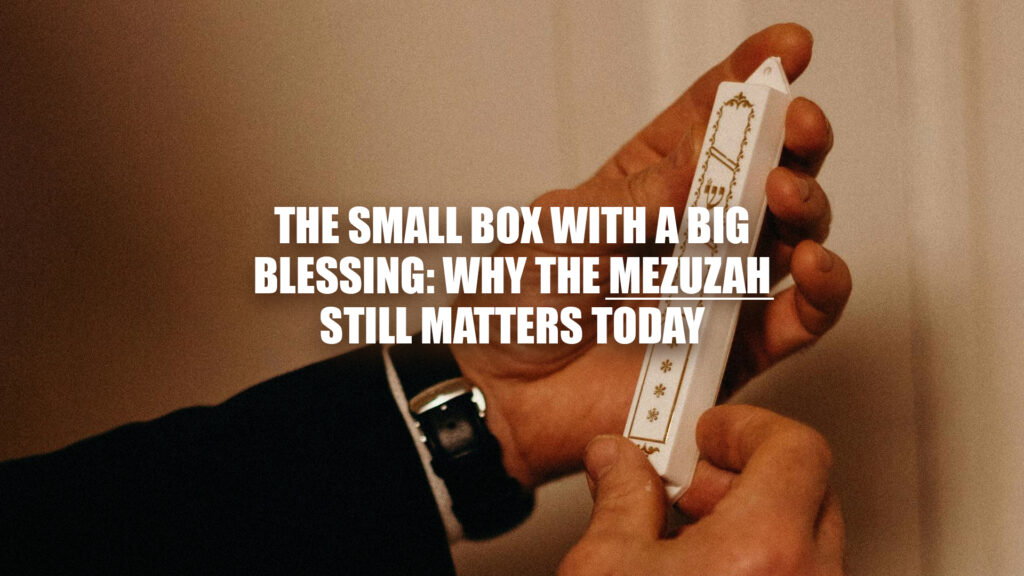
There are moments when God takes something small—something simple—and fills it with eternal power.
The mezuzah is one of those moments.
At first glance, it’s just a small box on a doorpost. Easy to overlook. Easy to dismiss. Yet what appears ordinary on the outside often carries extraordinary spiritual significance on the inside.
God never instructed His people to retreat from everyday life in order to be spiritual. He never said to abandon homes, families, or work. Instead, He invited His people to bring Him into all of it—into their houses, their children, their routines, and their comings and goings.
That is exactly what the mezuzah represents.
When a Doorway Becomes a Declaration
In Deuteronomy 6, God gives a command that is both practical and prophetic:
“You shall write these words on the doorposts of your house and on your gates.”
The Hebrew word for “doorpost” is mezuzah. From that command came a simple yet powerful act of obedience—placing God’s Word at the entrance of the home.
Not as a lucky charm.
Not as religious decoration.
But as a declaration.
Every time a person walks through that doorway, it becomes a reminder:
God is Lord over this house.
God is Lord over this family.
God is Lord over every coming and every going.
Doorways matter in the spiritual realm. A doorway represents transition. And God’s instruction was clear—at every transition, place His Word there.
Words Carry Spirit—and Obedience Releases Power
If a book filled with destructive or occult words were placed in a home, most people would instinctively remove it. Even without fully articulating why, there is an understanding that words carry spiritual weight.
If words connected to darkness can influence an atmosphere, then God’s Word—living and powerful—invites His presence.
Placing God’s Word on the doorpost is not superstition. It is obedience. It is an act of dedication that declares, “This house belongs to the Lord.”
Blessed in Coming. Blessed in Going.
Inside every mezuzah is Scripture—most often the Shema—declaring the oneness of God and His covenant promises. Promises of provision, protection, favor, and long life.
God did not give this instruction without attaching a promise:
“That your days and the days of your children may be multiplied…”
Every departure becomes a sending.
Every return becomes a covering.
Jewish wisdom teaches that the mezuzah guards the home—not because of the casing, but because God honors His Word.
From Their Hands to Your Doorpost
This month, the meaning of the mezuzah becomes especially personal.
The mezuzah being offered has been crafted by Olim—Jewish men and women who have made the courageous journey home to Israel. Many of these families are among those helped through Project Aliyah flights, returning to the land of their inheritance.
The same hands that once packed their lives into suitcases, stepped out in faith, and began again in Israel are now crafting a mezuzah that will stand on doorposts around the world.
For those who give $135 or more, this mezuzah is sent as a thank-you gift—not something sold, but something shared. It represents a tangible connection between generosity, obedience, and the fulfillment of God’s promises to Israel.
Placing it on a doorpost becomes more than a personal act—it becomes a testimony that blessing Israel brings blessing back into the home.
Standing With Israel in a Critical Hour
Israel needs friends now more than ever. Scripture makes clear that God watches how His people respond to the nation He calls His own.
“I will bless those who bless you.”
A gift of $135 or more this month helps bring Jewish families home, provide lifesaving humanitarian aid, and strengthen Israel in a time of great need. At the same time, it honors God’s Word and invites His protection and promises over the home.
This is not about ritual. It is about revelation. It is about obedience. It is about partnership with God.
Keeping God’s Word on the doorposts of homes. Helping bring God’s people home to Israel. Standing faithfully until every promise is fulfilled.
“The Lord shall preserve your going out and your coming in from this time forth, and even forevermore.” (Psalm 121:8)
Your Best Is Yet To Come
LHM